The 509 in North Africa
Once the Allies had established the "Germany First" policy, the United States, Great Britain and Russia discussed plans on how best to liberate Europe from Germany. One of the options on the table was a direct assault across the English Channel. A plan code named "Sledgehammer" was devised to accomplish this objective. The second option was to land American Forces in North Africa assisting the British in eliminating Rommel's Africa Korps. The Americans and the Russians were in favor of Operation "Sledgehammer"; the British, on the other hand wanted to remove the more immediate problem -- the Africa Korps.
 Since 1941 the Africa Korps had pushed the British across
North Africa. With American assistance the British could finally eliminate the
Africa Korps, and after much debate convinced the United States to land in Northwest
Africa.
Since 1941 the Africa Korps had pushed the British across
North Africa. With American assistance the British could finally eliminate the
Africa Korps, and after much debate convinced the United States to land in Northwest
Africa.
Operation Torch was devised to carry out this goal. Operation Torch called for three amphibious task forces to land simultaneously along the sprawling French North African coast. To augment the amphibious landings, an airborne phase of the operation was added to secure two airfields near Oran, Algeria. The 509 Parachute Infantry Battalion (PIB) was tasked to perform the operation.
America's First Combat Jump Of The War
 The 509 PIB began their journey from airfields in
England and had to travel 1,500 miles to North Africa. The 509 was tasked with seizing
either the Tafaraoui airfield or LeSenia airfield, which was located south of Oran. What
was not known for certain was if the Vichy French forces in the area would fight with the
Germans or with the Allies. To cover either contingency, the allies devised two plans:
Plan Peace and Plan War. As the code names suggest, if the French decided to resist the
Allies, Plan War would be implemented and Tafaraoui Airfield would be seized via a
parachute night jump. If the French cooperated with the landings, Plan Peace would be
exercised and the 509 would air-land at LeSenia airfield with the assistance of the
French.
The 509 PIB began their journey from airfields in
England and had to travel 1,500 miles to North Africa. The 509 was tasked with seizing
either the Tafaraoui airfield or LeSenia airfield, which was located south of Oran. What
was not known for certain was if the Vichy French forces in the area would fight with the
Germans or with the Allies. To cover either contingency, the allies devised two plans:
Plan Peace and Plan War. As the code names suggest, if the French decided to resist the
Allies, Plan War would be implemented and Tafaraoui Airfield would be seized via a
parachute night jump. If the French cooperated with the landings, Plan Peace would be
exercised and the 509 would air-land at LeSenia airfield with the assistance of the
French. On the evening of November 9, 1942, the 509 PIB (techinically they were still designated the 2nd Bat. of the 503rd. They were designated the 509 upon arriving in North Africa) left England in 39 C-47's. The paratroopers were informed that Plan Peace was in effect. This relieved the men of the 509, who looked forward to a peaceful landing at LeSenia airfield. The 509's luck wouldn't last though. While over Spain, head winds scattered the planes. Furthermore, unknown to the paratroopers, instead of a peaceful reception, the French were resisting the landings. As some of the lead planes began their descent on LeSenia airfield, they came under intense antiaircraft fire. The pilots were able to avoid the airfield and land the planes on a dry lake bed west of Oran. Another group of planes, which included the 509's commander, Colonel Edson Raff, were heading toward the Tafaraoui Airfield Drop Zone. As they approached the airfield Raff noticed a column of tanks. After incorrectly determining the column was a group of enemy tanks, Raff ordered his men to jump and attack the column. Upon reaching the ground, it became obvious that the vehicles were American tanks moving inland from the invasion beaches. Eventually, both airfields were captured by American ground troops.
America's first combat parachute jump ended in confusion and disappointment. Raff's men wouldn't have to wait long before they would have a second chance to prove their capabilities.
Youks les Bains Airfield - A Toast To Victory
 Youks les
Bains airfield, located near the Tunisian border, was strategically important to the
Allies drive to German-occupied Tunisia. American Intelligence indicated that the airfield
was held by a garrison of German paratroopers. Raff viewed capturing Youks les Bains as
the perfect opportunity to showcase the true capabilities of his men and convinced
Headquarters that the 509 PIB was ideally suited for the mission.
Youks les
Bains airfield, located near the Tunisian border, was strategically important to the
Allies drive to German-occupied Tunisia. American Intelligence indicated that the airfield
was held by a garrison of German paratroopers. Raff viewed capturing Youks les Bains as
the perfect opportunity to showcase the true capabilities of his men and convinced
Headquarters that the 509 PIB was ideally suited for the mission.
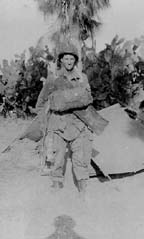
On November 15, 1942, the 509 boarded C-47 transport planes and headed for Yonk Les Bains. While over the airfield, they were surprised to find they weren't being fired upon. The 509 successfully jumped and landed near the airfield. Within several minutes the entire battalion was assembled and Colonel Raff ordered his men to dig in.
 Meanwhile, Raff
was approached by a small group of French Solders. One French soldier stepped forward and
greeted Raff with a handshake and a salute and identified himself as Colonel Berges, the
commanding officer of the Third Zouves Regiment.
Meanwhile, Raff
was approached by a small group of French Solders. One French soldier stepped forward and
greeted Raff with a handshake and a salute and identified himself as Colonel Berges, the
commanding officer of the Third Zouves Regiment.
The Colonel told Raff that he had been advised of his arrival by his superiors. Using his walking stick as pointer, Berges demonstrated that the entire airfield was ringed with concealed 75mm cannons and machine guns that were zeroed in on the drop zone, making a perfect killing field. Raff realized instantly that had the French chosen to resist the American parachute landing, the 509 would have been destroyed.
The Colonel then invited Raff and his staff, over to his command post. The French uncorked several bottles of wine. Colonel Berges then raised his glass and said with great emotion "This marks the beginning of a new hope for France. Together we will drive the Germans out of Tunisia and then we shall liberate France!"
After the toast, the Colonel then removed the badge of the Third Zouves Regiment from his tunic and pinned it on Raff's jump jacket saying "From this Day Forward, my Regiment is your Regiment." The deeply moved Raff presented Berg an American flag. The ritual marked a lasting bond of friendship between the two units.
 Within a week after
the drop, the 509 was bolstered by the addition of a tank destroyer company and two
sections of British Engineers. With the increased firepower, the 509 conducted numerous
raids across the Tunisian border to engage the Germans, including a small airborne assault
attacking Rommel's supply lines at El Djem Bridge.
Within a week after
the drop, the 509 was bolstered by the addition of a tank destroyer company and two
sections of British Engineers. With the increased firepower, the 509 conducted numerous
raids across the Tunisian border to engage the Germans, including a small airborne assault
attacking Rommel's supply lines at El Djem Bridge.

 For the next several months the
509 was broken down into small combat teams and scattered throughout Tunisia. The individual units fought with distinction in numerous
skirmishes as "leg infantry" including stopping the Africa Korps at Kesserine
Pass. With the Axis collapse in North Africa, the widely scattered 509, was reunited and
transported via train to Oujda, French Morocco. The 509 then prepared for the their next
combat jump, which they knew would be somewhere in Europe.
For the next several months the
509 was broken down into small combat teams and scattered throughout Tunisia. The individual units fought with distinction in numerous
skirmishes as "leg infantry" including stopping the Africa Korps at Kesserine
Pass. With the Axis collapse in North Africa, the widely scattered 509, was reunited and
transported via train to Oujda, French Morocco. The 509 then prepared for the their next
combat jump, which they knew would be somewhere in Europe.