
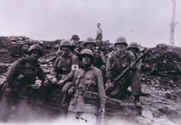
Joe Watts and other members of
his platoon in Italy.
Introduction and editing
by Carl A. Fornaris, Drop Zone volunteer
September 13, 1943 was a day of crisis for the shrinking British and American beachhead in and around Salerno, Italy, which had been invaded just four days earlier by the Allies. Shortly after mid-day, German troops – in a concerted effort to drive the Allies into the sea – attacked the Salerno beachhead from the surrounding towns of Vietri, Battipaglia, Eboli, and Altavilla. By the end of the day, the Germans were less than five miles from the beach. German propaganda broadcasts claimed another Dunkirk victory, as the Allies seriously contemplated an evacuation of their forces at Salerno.
The only hope for quick assistance lay with the United States 82nd Airborne Division, which was in Sicily and available for commitment. On the morning of September 13th, General Mark Clark had a letter sent by plane to Major-General Matthew B. Ridgway, the division commander of the 82nd. Informing him that the fighting in the Salerno beachhead had taken a turn for the worse, Clark wrote:
"I want you to accept this letter as an order. I realize the time normally needed to prepare for a drop, but . . . I want you to make a drop within our lines on the beachhead and I want you to make it tonight. This is a must."
That evening, the First and Second Battalions of the 82nd Airborne Division boarded C-47s, and shortly before midnight on September 13, 1943, about 1,300 paratroopers jumped into the beachhead near Paestrum and were quickly trucked to positions along the final line of defense. Then 20-year-old Joe Watts was one of those troopers. In his e-history, Joe recalls in vivid detail his memories of that drop and the subsequent fighting against the veteran German XXIX Panzer Division near Altavilla, Italy.
ALTAVILLA
504th PIR Uniforms and Equipment
For Sicily and further combat, up to and including Operation Market Garden in September 1944, the 504th Parachute Infantry Regiment ("PIR") wore the issue jump suit: sand-colored, light weight khaki pants and bush jacket; the pants or trousers had the usual pockets with large patch pockets added at the knee, one per leg. They were pegged to fit into the calf-high leather jump boot. Most men used a needle and thread to place a tack about six inches from the bottom of each leg then broke the seam to the tack so the pants could be pulled on and off without having to remove the boots. Suspenders were issued with the pants. The jacket was full sleeve, action back, with four large patch pockets: two over the breasts and two on the skirt. There was another zipper pocket just under the chin button concealed in the folds for the issue, switch blade, jump knife. A 3x4 American flag sewn on the left shoulder, sometimes the 82nd signal patch on the right. Good soldiers removed one or more threads from suspension line cord and used them as threads to sew reinforcing seams on all of the pockets. In all of these pockets were grenades, both smoke and fragmentation, approximately a pound of composition C-3 explosive, sundry blasting caps and fuses, bits and pieces of K-Rations and D-Rations (the chocolate bars), at least one pair of clean socks, one or two condoms to protect the barrel of your weapon from rain and dirt, yards of salvaged suspension line for all kinds of tasks. Over this was a pistol belt with compass, first aid packet, canteen, bayonet, intrenching tool, sheath knife, possibly a .45 Caliber pistol holster and magazine pouch; all supported by a web harness with two D-rings at the shoulders where a musette bag could be attached, and another sheath knife taped to one shoulder web and a Parachute first aid kit taped to the other shoulder web. This first aid kit had a serrate of morphine - - mine dried up before I had a chance to use it, at Anzio. When in the assault, the musette bag was dropped with the bed roll for the supply sergeant to bring up later. Usually when we attacked we had the idea we would use the enemies’ blankets that night or hospital blankets if we needed to keep warm. We never thought much about our bed rolls except as comfort items where an extra shirt or underwear could be found. We seldom missed the bed roll. Over all this was the helmet, which consisted of helmet liner with jump chin strap attached and one or two rolls of K-Ration or 5-in-1 toilet paper in a pouch between the web and the top. Over this the steel helmet fit with strap and quick-release snap that went under the chin when jumping and was found tightened across the back, lip, of the helmet most other times. Most helmets were dull, olive-drab paint. There were some that retained the maneuver camouflage paint jobs. Most had the card-game symbol for a club on the side, painted red, white, or blue for one of the three battalions. White being Second Battalion. In North Africa, the 504th PIR wore issue, green, coveralls instead of jumpsuits. We were issued two jumpsuits, but they didn't have much staying power, neither did coveralls with all that heat and sweat. The shoulder seams of clothes disintegrated from perspiration salt. And, in Italy, the quality of the jumpsuit that made it attractive during the warm weather, made it unsuitable for wear during an Italian winter. We wore parts of the jumpsuit with the blanket-lined Tanker bib overalls and jackets at Anzio. We wore issue wool shirts and sweaters under the jump jacket. We, the men of the 504th PIR, were distinctive in that jumpsuit. We were the only regiment to wear it into Holland. The others wore the new green field trousers and jackets we weren't to be issued until November 1944. Even then we wore our musette bag and harness with all accouterments attached to the belt. Some of us wore our .45 pistols in shoulder holsters under our harnesses, so if we had to run, and we were forced to drop our harness, we would still have a means of defense. And if we were riflemen, we wore from two to three bandoleers of .30 caliber ammunition in eight round clips, six clips per bandoleer. Some of the guys had the infantrymen's rifle belts instead of pistol belts. They had pockets for ten clips of eight rounds. I usually carried up to three bandoleers with four fragmentation grenades hooked on the bandoleers.
Rome Drop Cancelled
On September 5, 6 and 7, 1943, the Division was airlifted from Tunisia to Sicily. The First and Second Battalions of the 504th PIR were sent to Trapani, Sicily. The Division command post was at Licata, Sicily. F Company of the 504th PIR – my company – was bivouacked at the northeast end of the main runway in olive groves amid wrecked German aircraft, engines and parts. We had a beautiful panorama of olive groves and grape vineyards to the north and east. Our bivouac was part of a regimental defense for the airfield as well as our marshaling area. The other companies of the two battalions were so deployed. After all, there were still Germans on Mt. Etna.
About 1700 hrs on September 8th, at Trapani, Sicily, after officers’ call to regiment, the First and Second Battalions of the 504th PIR were assembled by individuals companies and briefed. We were to parachute on an airfield north of Rome and hold until reinforcements arrived, within three days. We began scurrying around; re-rolling bundles and packing up. C-47s began circling the airfield for landing as trucks arrived in the Company area. The C-47s were coming in from all over Sicily and Africa. The trucks took us toward the refueling aircraft as an officer in a jeep shouted tail numbers for each unit. At our assigned aircraft, we separated equipment as a truck manned by riggers drove from plane to plane, issuing personnel and bundle parachutes. We mounted our bundles on C-47 para-racks, extra bundles were designated door-bundles. Once the labor was complete, we chuted up, and loaded. We began to taxi. The First Battalion aircraft were in the air and forming up to fly to Italy when jeeps came screaming onto the tarmac among the Second Battalion taxiing aircraft. Badoglio had renounced the armistice terms -- he needed more time. The Rome operation was canceled. The airborne aircraft returned to the airfield and we went back to our bivouacs. The next morning we learned that several Panzer units were manning our proposed drop zone. It would have been a hot time in old Roma.
Salerno: Airborne to the Rescue
A day or two passed and to stay in shape, F Company/504 PIR went on a road march. From our bivouac on the airfield, we hiked across town and up the mountain road to the Kipling's "city in the clouds" above Trapani, Sicily. We had just arrived at the top of the hill and were looking forward to melons and rest, maybe beer and wine when, again, a jeep screamed up the road with an officer from Battalion standing and holding onto the windshield frame, shouting for us to return to the airfield immediately, we were to load for a drop that night. We jogged most of the way down that hill in one third the time it took to climb, arriving in our bivouac at about 1600 hours, as again, C-47s were circling to land like buzzards around road-kill. We were briefed on the run: jump to relieve the pressure on U.S. 5th Army at Salerno. They were being pushed into the Gulf by the Krauts. General Mark Clark had asked for us!
Just after dark, I have no idea what time we took off, eighty-two planes, thirteen hundred troops, Danny Danielson's Second Battalion and Captain Beverly T. Richardson’s F Company leading in 36 planes in the van, flew in V of V's to the east north east. Most of us slept for an hour and hoped there would not be a reoccurrence of our first combat jump [Editor’s note: During the 504th's Sicily drop, Allied naval warships mistakenly fired at their own paratroopers, causing numerous casualties]. But well before we neared the Italian coast, we were ordered to stand and hookup. We were ready in the event our plane was hit by enemy fire. So it was with relief, we had been bending over from the tight harness and load of our chutes and packs for about twenty minutes when, at 2326, 12 September 1943, we jumped from 600 to 800 feet, into bella Italia. What a relief. No antiaircraft or enemy planes to greet us. As I exited the door, there was a large T beginning to light up below me on the DZ. I later learned it was our old battalion commander from Sicily, Bill Yarborough, that arranged the gasoline drums and lighted the ‘T.' The First Battalion, because of aircraft troubles, jumped between 2345 and 0230, 13 September, behind us. We assembled but had lost about six or eight troopers from 1st Platoon as they hit some rock walls just to the south of the DZ. Some broken bones and bruises but our hosts, the U.S. 36th Infantry Division, had medical facilities to handle them. We assembled along the line of flight, moving up the DZ to the east. At the end of the DZ we boarded trucks and moved east and north. We drove past the ruins of an ancient temple at Paestum. There was a towed 37mm antitank gun manned by GIs pointing down the road from the direction from which we had come. It seemed silly, incongruous, for this tiny gun and twentieth-century soldiers to be standing in front of these very ancient ruins, ruins that resembled pictures of the Parthenon in Greece. We continued up the road to finally be off-loaded somewhere between the 36th Infantry Division line to the north and Monte Soprano to our south.
I spent the early hours of the morning, until daylight, cleaning my rifle while resting beside a dirt road in a freshly tilled tomato patch. I was still a Company runner. That meant I did anything the CO thought necessary: carry messages to the platoon leaders on the line, carry water or ammo to these same platoons, run messages to Battalion, carry and communicate on the SCR 511 or 536, be a point man or connecting file on the march. Any thing that needed doing and where a squad wasn't required, I had to be prepared to do. Later that morning after moving into a Company assembly area on the reverse slope of a hill mass slightly south and west of Albanella, I was sent on a run to locate 1st Platoon and have the leader report to the CP. On my way back I had time to sit down on a hill side a watch a tank-to-tank battle taking place on the plains to the north along the Calore river. German tanks would fire on some of our tanks and tank destroyers. A round would land near a tank, the tank would return fire then move up and to the right or left, another incoming, the tank would again fire and move. Fascinating!
We were told the 505th PIR would be coming in on September 15th. Near midnight C-47s began dropping the 505th. One of their aircraft got lost and dropped them near Battipaglia, fortunately in the British sector. Two weeks later the entire Regiment was assembled. However, before dawn on the 15th, the 505 was on line behind us from Albanella to Agropoli, extreme southern end of the beachhead, in VI Corps’ "reserve" and their commander, then-Colonel Jim Gavin, became advisor to General Mike Dawley. We heard the 505 consider this the best mass night jump they had ever made.
Concurrently, now September 15th, the 509, Doyle Yardley commanding, launched the first Allied parachute drop, behind the fixed, active and alerted enemy lines, at Avellino, Italy. Of the 640 men, 520 filtered back to the lines doing random and minor sabotage and harassment. At Altavilla, two days later, we were told to watch for them as line crossers.
September 16, 1943: Early morning, F Company of the 504 was ordered to move up the hill to friendly-held Albanella. All day on the march dodging enemy artillery. The approach to Albanella was generally under observation from the hills of Altavilla to the north, and, this entire area had been part of an artillery range and training area for the enemy. They had every junction, crossing, bridge and culvert plotted and registered. After dark that night, amid enemy H&I fires, we moved across the valley on a nearly direct line north in what was a donkey and sheep path during the dry season and a waterway during the wet season. It was lined with field stones. The walkway, the sides, all of it was of large stones. The sides were like walls, up to ten feet high. They might protect you from artillery landing in the fields on either side, but most of the shells landed in the trail, ahead or behind, thankfully. We took lots of casualties since the Germans knew the area very well and had registered on all of it. Our objective was the heights above the town of Altavilla, and to get there we had to plod along in the dark. There was some white engineer tape for part of the way, but that disappeared sometime during the night. I was following Benny Mustari, the CO’s runner for the day. Benny was following the old man. One rifle platoon was in front of us and two behind. After a near miss and getting some organization back into the march, someone said: "pickup that ammo can!" I looked around and found a can of machine gun ammo, sitting on a rock. I picked it up. I carried that damn thing for hours. Scrambling over rocks, falling between them, banging the can and my knuckles against the rocks, all night long. I had never realized how uncomfortable those little handles were on those machine gun ammo cans. Nor how much 250 rounds of .30 caliber MG ammo weighed. It got heavier by the minute. But up we went through the dark, trying to be as quiet as possible, whispering commands to halt, move out, cussing and shushing the noise-makers like me, ever forward. We'd stop to allow the scouts to do their job and someone in the column would fall asleep. We'd get ready to move out and there would be a break in the column. When discovered, the word would be passed up to hold up, and the word would be passed down to catch up. Squad leaders were constantly counting their men. I stayed in contact with the man in front of me, Benny Mustari. After a long time I realized I could see the difference between the tops of the trees -- there were a lot of trees, old trees -- and the sky. It was getting light, morning was coming. Already the column point was being sporadically fired upon. The dark and loss of contact resulted in many of the squads breaking into their Able, Baker, Charlie, components and engaging the enemy with from 3 to 12 men wherever they found him. And as visibility improved, the chances of encounters with enemy outposts was increasing.
Fending Off the XXIX Panzer Division Around Atlavilla
On the morning of the September 17th, on the hills around the town of Altavilla, you could hear small arms popping all over the hills. Small fire fights were developing wherever troopers and Germans found one another. The march rate quickened as the trail across the valley opened up on the hill and the lead elements were spreading out to reconnoiter and engage the Germans. I had to jog to keep up with Benny. The stone walls disappeared as the route changed from a gully and draw to woods, vineyards and meadows again. Bullets were cracking overhead in the zipper sound we all came to associate with the Schmeisser, MP 38, machine pistol. Kind of a ripping sound at 500 rounds per minute with those little 9mm rounds rather than a distinct crack or pop of a Thompson submachine gun and .45 caliber rounds. I was caught between trying to find cover from flat-trajectory fire, shelter from mortar and 88mm shells tree-bursting overhead, and keeping track of the CO and/or Benny. The Captain had a strip of white medical tape on the back of his helmet, so I could identify him, but unless Benny was walking or running, I couldn't spot him. A couple of times I thought he had left me behind and went charging up or across a slope when Benny would holler at me from the rear. And I still had that damned can of ammo in my left hand -- it balanced my M-1 rifle in the other. As far as I knew, the CO, Benny, and I were all alone up there, even though I could hear pitch-battles taking place to my right, left and behind me. I don't know who, or if anyone, was following me. Captain Richardson carried an M-1 and I could see him frequently sighting, aiming and firing up or across a hill. Neither Benny nor I could see anything to shoot at. We had slowed down in our advance when a guy from 1st Platoon came sliding down a little draw to where the CO was. The CO then looked back at me and waved me up. This was the CP. I was ordered, with my can of ammo, up the hill with the guy from First Battalion, to pass the word to establish a defense and for the Leader, First Battalion, to return with me to the CP. I don't know what time it was but with all the excitement and running, I was getting thirsty. The last time I filled my canteen was in Albanella. I was running low on water.
We arrived at the CP 1st Platoon, just below the crest of a ridge looking north with the roof tops and church tower of the town of Altavilla visible to our left rear, south west, toward the beach. The Germans of the XXIX Panzer Division were down the forward slope preparing for a counter attack. The rest of the Company and Battalion were coming on line to the right and left of 1st Platoon. Just about that time the Germans jumped off and one of 1st Platoon’s A-4 machineguns called for ammo. The 1st Platoon guide that had led me to their CP told me to take the ammo over the crest and down the forward slope to them. But first, amid the shell fragments falling around us, we had to open the can and stretch the belts so the gunner would be able to use it immediately, and there would be the space to do the stretching over there. So, we twisted and pulled on that canvas belt so the cartridges could be extracted and not cause a stoppage.
Now we had gone through this exercise in Africa and again in Sicily with ammo fresh from the manufacturer, four-can crates, and before bundling the cans with the guns. So I would have thought this can had been stretched. But the Platoon wasn't taking any chances of a stoppage since some new ammo fresh from crates had been issued prior to jumping off from Albanella, so twist and pull we did. Preliminaries completed and the ammo belt back in the can, I was told to go to the next tree up the hill, then cross the ridge on a straight line, down the slope and I would see the MG position. And away I went. I wanted to make a good impression on these platoon guys, show them we in Company Headquarters could fight a war too, so I moved as directed without hesitation. As I crossed the crest of the hill I realized I was taking fire. The enemy could see me and I was their target. I then changed tactics and began to run and dodge, down the slope looking for our machinegun position. I heard someone holler for me to get down. I flopped and looked around. I hadn't realized I had come down that slope so far, so fast. Because, about twenty yards back up the hill, was our MG position. I was between them and the enemy and drawing fire. Without thinking, I jumped up again, my rifle slipped out of my right hand, I stopped, picked it up, then it seemed as though in one long jump, I landed in the hole with three guys manning that MG. I gave them the ammo and without further adieu, I jumped out of the hole with my rifle now at high port, and charged up and across the crest of that hill with bullets and artillery fragments kicking up dirt around my feet and cracking around my ears. A couple of times something pulled at my floppy pants and my jacket, but I attributed these to bushes as I passed through. Several days later, when I had a chance to remove my jacket, I found three places where bullets or shell fragments had torn at my jacket arms and skirt without cutting my skin. Once on the backside of that hill I slid into a depression and had the last of my water with a nice piece of K-Ration cake.
The Germans made a valiant effort at taking the hill crest but our forward slope defense drove them off. Now the 88's began snipping at our hastily dug forward positions. We noticed the tank would fire their gun then, contrary to policy, not shuffle or move to a secondary firing position. This eventually led Major Gorman, our Regimental S-2, to issue the statement the enemy was running out of fuel for their tanks so we didn't need to worry about Panzers accompanying their infantry assaults. This was encouraging, but it didn't damage their accuracy. Over in E Company some of the troops were literally dug out of their holes by 88s. As a consequence, that night after dark, Colonel Tucker ordered the regiment to take up reverse slope defense positions: the final protective line laid in on the crest of the hill. With all three platoons on line, the Company CP was just to the rear of the platoons with the security responsibility of the Company rear. Every once in a while one of our guys would come down the hill with his rifle at high port pushing one or two Krauts in front of him enroute to the POW enclosure below us. About this time we learned the enemy’s firing on our reverse slope and rear area positions was so accurate because they had an OP behind us, near the Castle on Monte Soprano. A combat patrol from Regiment went back there and took it out. During one German breakthrough on our right, enemy soldiers tried to return to their lines by circling behind us and moving up the draw between us and Altavilla. But we killed two and captured three that night. The next morning one of the U.S. ships in the Gulf fired its big guns – 12-inch or bigger -- at the enemy, but one or two rounds fell short. They landed behind our Battalion.
Regiment moved their CP into one of the craters, the other was as a repository for friendly and enemy dead until the battle was over and proper GRU personnel could clean up the battlefield. During the morning lulls, our Company 1st Sgt. Lee, sent me to work on the Battalion GRU team. The Battalion Surgeon directed us to gather the dead, friendly and enemy, or their remains, by smelling them out, placing them on very odoriferous litters, and moving them to the crater for temporary burial. These were the days before body-bags. I spent most of two days retching and in the evenings when I returned, no one at Company would have anything to do with me because my clothes retained that smell of the dead.
Things were stabilizing in our favor, the enemy tanks were running out of fuel, but not ammunition, and Colonel Tucker was advised our Third Battalion had landed on the beach via LCI but retained as Clark's reserve. Later, as the XXIX Panzer Division tried one big push, which proved to be their last on that battlefield, Colonel Tucker was asked by higher command if he wanted to withdraw. He commented something to the effect: "Hell no! Just send me my other battalion." That was a guy worth soldiering for. And to the end of the war, May 1945, Ruben H. Tucker, Colonel, Infantry, commanded the 504th Parachute Infantry Regiment. He just didn't want to leave our sorry asses in the mud. He had trained that Regiment and he fought for it. Thank God! Or many of us would not have survived.
Source: J. C. Watts, Jr. thru Carl Fornaris